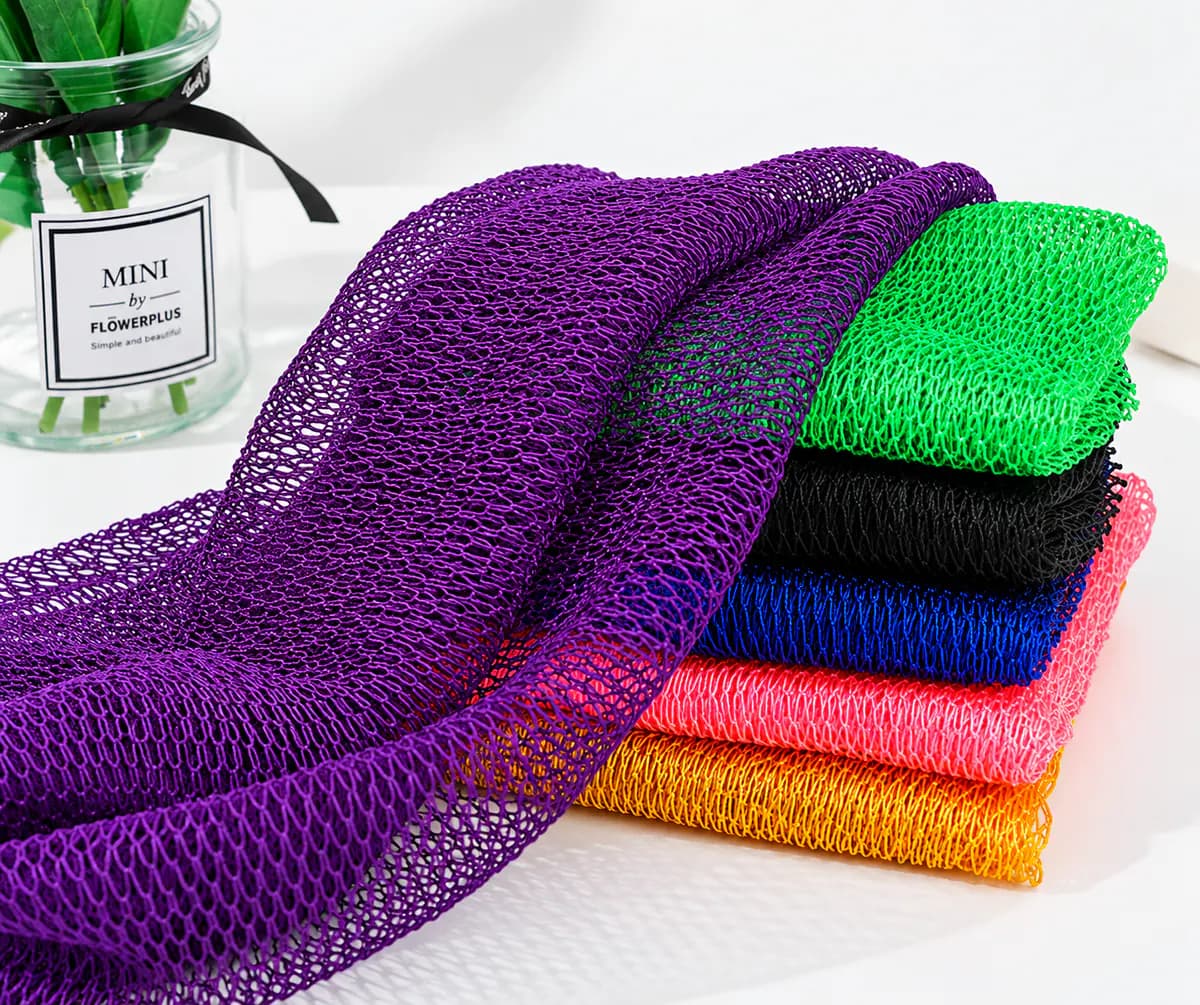
For an importer, the phrase “African net sponge” identifies a product category, not a complete material specification. Two products can look similar in a catalog and still differ in polymer, strand construction, mesh openness, stretch recovery, surface feel, edge treatment and finished weight. Those differences affect how a sample feels in the hand, how consistently units can be packed and how easily a repeat order can be matched.
This guide explains how wholesale buyers can verify African net sponge material and construction without relying on an unqualified “nylon” description. It is designed for importers, distributors, private-label brands and online retailers comparing samples or preparing a specification. For supply formats and the wider purchasing workflow, start with the African Net Sponge Wholesale Buying Guide.
African Net Sponge Is a Product Name, Not a Polymer Certificate
FishingNetPro's manufacturing partner has confirmed that African net sponge products can be supplied in nylon and polyester. The material still has to be identified for each quoted product: buyers should not assume that every item sold under the category name is 100% nylon, or that nylon and polyester versions share the same construction, dimensions or commercial terms.
Product names, marketplace listings and visual appearance are not sufficient evidence of material composition. A quotation should state the proposed material in writing. If the purchase contract requires nylon, the order specification should identify that requirement rather than relying on the generic product name.
The material line on an RFQ should therefore state nylon or polyester, or ask the manufacturing partner to propose and declare the material. If composition is contractually important, request the appropriate supporting documentation for the exact product rather than relying on a category name or photograph.
Nylon and Other Possible Synthetic Fibers
Nylon and polyester are confirmed supply materials, but no laboratory performance comparison has been provided. The table below focuses on what a buyer should verify rather than assigning untested claims to either material.
| Material description in an offer | What the buyer should verify | Why the label alone is insufficient |
|---|---|---|
| Nylon | Exact material declaration, strand construction, color, hand feel and sample match | “Nylon” does not define mesh geometry, finishing or finished dimensions |
| Polyester | Exact material declaration, construction, color and comparison with the target sample | A similar appearance does not make it interchangeable with nylon |
| Recycled-content or other material claim | Written factory confirmation and suitable evidence for the exact product | No such claim should be inferred from color, price or product name |
When a specific fiber is mandatory, ask what evidence can be supplied for the exact order. Do not infer certification, recycled content, antimicrobial treatment, dermatological performance or other properties unless valid evidence applies to the product being purchased. No comparative durability, drying, exfoliation or elasticity test result is claimed here.
Confirmed Colors, Sizes and Order Basis
The manufacturing partner has confirmed red, yellow, blue, purple, pink, green and black among the available color references. Other requested colors can be reviewed, but availability and quantity remain subject to order confirmation. The real bulk photograph planned for this article supports the existence of multiple product colors; it does not establish a fixed stock list or production volume.
Different lengths and sizes can be produced. Weight varies with length, material and the confirmed mesh specification, so this guide intentionally does not publish a universal size or unit weight. Buyers should request a quotation using the actual material, dimensions and construction they need.
The confirmed starting MOQ is 1,000 pieces for finished African net sponges and one roll for uncut mesh rolls. Color splits, special dimensions and packaging may create additional feasibility or component-minimum requirements and should be confirmed before treating those minimums as applicable to every SKU.
How Mesh Structure Changes the Product
Material is only one part of the product. The mesh structure determines how the open fabric expands, gathers and returns toward its relaxed form. Buyers should compare the following attributes on samples shown under the same conditions:
Mesh openness and opening shape
Review a close-up of the mesh in a relaxed condition and, if useful, under a defined extension. An image taken with the material pulled tightly can make openings appear larger and more regular than they are when the product is handled normally. Include a ruler or another agreed scale in comparison photographs.
Strand or yarn construction
Ask the supplier to describe how the visible strands are formed. Do not transfer fishing-net terminology such as denier/ply, SK/DK knots, MD depth or LWSF/DWSF stretching unless the manufacturing partner confirms that a term genuinely applies to the bathing mesh. A bath-net specification should use terms both parties understand and can verify on a sample.
Flexibility and recovery
Words such as “soft,” “firm,” “elastic” and “stretchy” are subjective. A buyer can make them more useful by comparing an approved reference and candidate sample side by side. Record the sample condition, dimensions and how it was extended. The objective is repeatable comparison, not an unsupported performance claim.
Fabric density and finished weight
A more open appearance does not automatically mean a lower finished weight, and unit weight does not by itself define mesh quality. If weight matters to packaging or retail presentation, specify how the finished piece is conditioned and weighed. Confirm dimensions and construction separately.
Finished Pieces and Mesh Rolls Need Different Checks
Finished African net sponges and uncut bath-net mesh rolls share material questions but create different inspection priorities.
| Quality point | Finished sponge | Uncut mesh roll |
|---|---|---|
| Material | Confirmed against the order and approved sample | Confirmed for the supplied roll material |
| Dimensions | Finished length and width under an agreed condition | Usable width plus agreed roll quantity basis |
| Ends or edges | Cut and finished condition checked by unit | Roll edges, joins and continuity reviewed where relevant |
| Color | Compared by approved reference and quantity by SKU | Compared by approved reference and roll identification |
| Weight | Unit weight only if specified and measured consistently | Roll weight only if it is the agreed commercial basis |
| Packing | Unit, inner pack and outer packing | Roll wrapping, identification and outer protection |
Buyers without local cutting and finishing capability usually need a clearly defined finished unit. Converters may prefer rolls, but they should account for cutting consistency, waste, end finishing and local packing rather than comparing only the material price.
Edge and End Treatment
The ends of a finished bathing net should be evaluated as part of the product specification. Ask how the piece is cut and how the end is secured or presented. If a seam, tie, closure or another treatment is required, identify it with a drawing or approved sample instead of using an ambiguous label.
For mesh rolls, clarify the expected edge condition and whether the order needs any identification of joins or material changes. Do not assume that a small swatch proves full-roll continuity. Roll-level requirements need separate production confirmation.
Sample Quality Inspection Checklist
Use one controlled reference for all suppliers and retain the approved sample after commercial confirmation.
- Confirm whether the sample is a finished sponge or uncut mesh.
- Record the supplier’s written material declaration.
- Photograph the relaxed mesh close-up with an agreed scale.
- Record finished dimensions and the measurement condition.
- Compare flexibility and recovery with the reference sample using the same handling method.
- Check visible consistency of openings, strands and color.
- Inspect cut ends, seams or other end treatment on finished units.
- Note odor, visible contamination, loose fragments or obvious damage without making medical or safety conclusions.
- Check unit weight only under an agreed conditioning and weighing method.
- Compare the proposed packing with the actual sales channel.
- Confirm whether the inquiry is based on the finished-product MOQ of 1,000 pieces or the mesh-roll MOQ of one roll.
- Assign a sample code and approval date so the reference is traceable.
- List attributes the sample does not establish, such as full-roll continuity or bulk color consistency.
Common Purchasing Mistakes
Treating “100% nylon” as a default fact
The material should be confirmed for the exact product. Do not repeat an unverified marketplace description in the purchase order.
Approving from a photograph only
A photograph can show color and visible mesh shape, but it cannot reliably establish material composition, hand feel, recovery or unit weight. Use a representative physical sample when these attributes matter.
Comparing samples under different stretch conditions
One sample photographed relaxed and another pulled tightly will not provide a useful comparison. Define the condition and measurement points.
Using fishing-net specification codes
Bath netting should not inherit MD, knot, selvage or fishing-net mesh codes unless the factory confirms their relevance. Unfamiliar terminology can create false precision rather than clarity.
Assuming one sample proves a complete production run
A sample establishes only the attributes it was designed to represent. Bulk color consistency, roll continuity, packaging execution and production tolerances require agreed inspection points.
A Practical Material and Quality RFQ
An effective inquiry can state:
Supply form: finished African net sponge / uncut bath-net mesh roll
Required material: specify if mandatory, otherwise request supplier declaration
Reference: sample code or attached close-up photographs
Dimensions and measurement condition: ___
Mesh structure and hand-feel reference: ___
Color and quantity by variant: ___
End or edge treatment: ___
Unit or roll weight requirement, if applicable: ___
Packing and labeling: ___
Destination and estimated order volume: ___
Unknown values should remain marked for confirmation. The Request Quote form allows buyers to send requirements and supporting files for review.
Frequently Asked Questions
Are all African net sponges made from nylon?
No. FishingNetPro's manufacturing partner has confirmed nylon and polyester options, and the material must be stated for the exact product. “African net sponge” should not be treated as proof that every item is 100% nylon.
How can a buyer verify African net sponge material?
Start with a written supplier declaration and representative sample. If composition is contractually important, ask what supporting documentation or agreed verification can apply to the exact product and order.
Does a larger mesh opening mean better quality?
No. Opening size is one construction attribute, not a universal quality grade. The appropriate structure depends on the target product, dimensions, handling and approved reference.
How should softness or firmness be specified?
Use a physical reference sample and a consistent comparison method. Descriptive words alone are subjective, so record the approved sample code and relevant construction details.
What should be checked on a finished sample?
Check declared material, relaxed dimensions, mesh appearance, flexibility, recovery, visible consistency, color, end treatment, unit weight if specified and the proposed packing format.
Can an illustrative website image be used as the production standard?
No. Illustrative images help identify the product category but do not establish material, exact color, dimensions or construction. Bulk production should follow an approved specification and representative sample.
What is the MOQ for finished products and mesh rolls?
The confirmed starting MOQ is 1,000 pieces for finished African net sponges and one roll for uncut mesh rolls. Exact SKU, color and packaging feasibility still has to be reviewed for the proposed order.
Prepare a Material-Led Inquiry
Send the supply form, required material or reference sample, dimensions, mesh close-up, colors, quantity and packing concept. FishingNetPro can ask the manufacturing partner to review feasibility and identify which fields still need confirmation before quotation.
View African Net Sponge supply options or request a specification review.