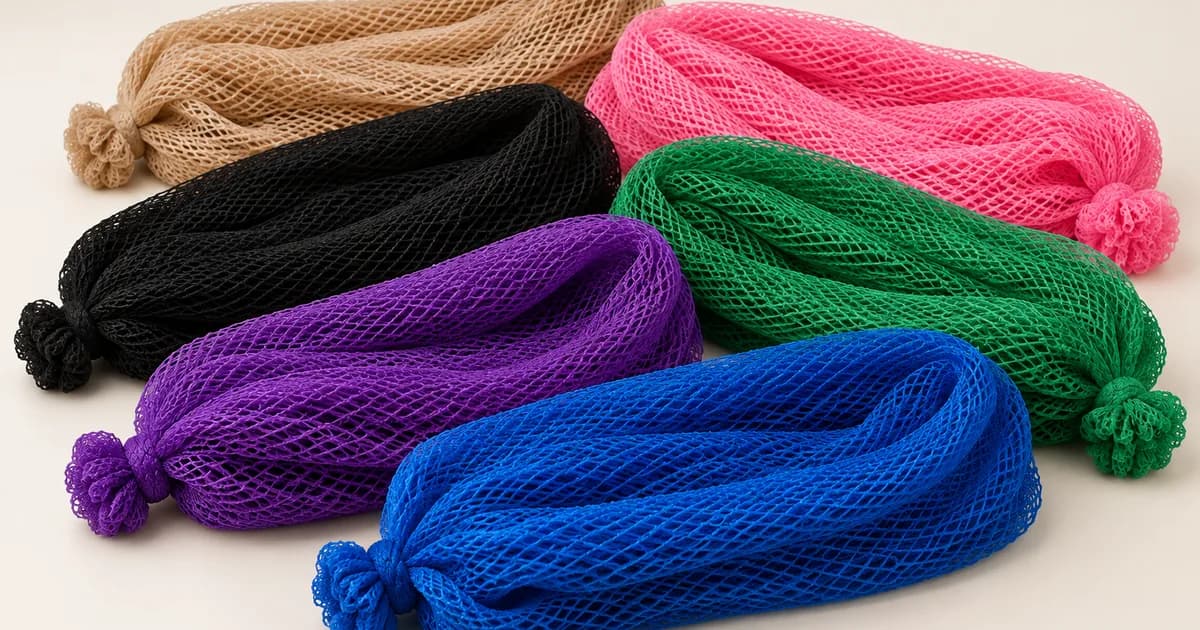
African net sponge wholesale orders usually begin with one decision: buy finished bathing nets or import uncut African bath net mesh rolls. The two formats can use similar open-mesh material, but they create different work for the buyer. Finished pieces reduce downstream preparation, while rolls give a processor more control over cutting, finishing and packaging.
This guide is for importers, wholesalers, distributors, private-label brands and online retailers comparing those supply routes. It highlights questions to resolve before quotation and sampling; material, size, MOQ and packing still require order-specific confirmation.
Wholesale Buying Priorities
Supply Form
Decide whether the order is for finished pieces or uncut mesh rolls.
Material
Confirm the proposed polymer, construction and hand feel against a reference.
Dimensions
Define the product condition and method used for every measurement.
Mesh Structure
Approve openness, flexibility, recovery and edge or end treatment.
Packaging
Specify the sales unit, inner packing, labels and outer carton or bulk pack.
Sample Approval
Record the approved reference and any limits it does not establish.
Finished Sponges vs African Bath Net Mesh Rolls
Finished African net sponges are pre-cut units prepared with the agreed dimensions and end treatment. They suit buyers that want to receive a defined item for wholesale or retail packing. Mesh rolls are uncut material for businesses that can convert the fabric locally or supply it to downstream processors. A roll purchase transfers more responsibility for cutting consistency, waste control, finishing and unit packing to the buyer.
| Buying Factor | Finished African Net Sponges | African Bath Net Mesh Rolls |
|---|---|---|
| Best suited to | Wholesalers, brands and retailers seeking prepared units | Converters, packers and distributors with processing capacity |
| Buyer's downstream work | Usually labeling, packing or distribution after inspection | Cutting, end finishing, unit inspection and packing |
| Key dimensions | Finished length, width and end treatment | Usable roll width, roll length or agreed quantity basis |
| Quality focus | Piece consistency, finished edges, color and unit packing | Mesh consistency, usable width, roll continuity and processing yield |
| Inventory flexibility | Defined SKUs are ready for the intended program | Material can support several downstream formats if compatible |
| Quotation basis | Quantity by finished variant and packing format | Roll specification, quantity basis and packing format |
The better option depends on operational capability, not simply order size. A retailer without conversion equipment may gain little from a lower roll price after labor and waste. A capable converter may prefer rolls because local cutting can support several product formats. Compare quotations only after each route has a complete specification.
Confirm Material by Evidence, Not Product Name
“African net sponge” describes a product category, not a complete material specification. Before placing an order, ask the manufacturing partner to state the proposed material and relevant construction details. If your market requires a particular composition, provide that requirement explicitly and request supporting product documentation where appropriate.
Use the African Net Sponge Materials and Quality Guide to compare nylon and polyester declarations, mesh structure, finished weight and sample inspection points without assuming that every product uses the same polymer.
Hand feel also matters. Buyers may evaluate flexibility, surface texture, stretch and recovery, but descriptive words such as soft or firm can be interpreted differently. A physical reference and a representative sample provide a clearer basis. Do not infer certification, recycled content, antimicrobial properties or test performance unless the supplier supplies valid evidence for the exact product.
Define Dimensions and Measurement Conditions
Net-like materials change shape when relaxed or stretched, so a number without a measurement condition can be misleading. For finished sponges, state the required length and width, whether the piece is measured relaxed or under an agreed extension, and how the ends should be cut or finished. If unit weight is important, add it as a separately confirmed field rather than using it as a substitute for dimensions.
For mesh rolls, confirm usable width and how roll quantity will be expressed and verified. Roll length, roll weight and usable yield are different commercial bases; never assume that one guarantees another. Record tolerances only after the supplier has reviewed them. A drawing with measurement points is especially useful when a current product is being matched.
Review Mesh Structure and Finished Construction
Request close-up images or a sample that shows the mesh in a consistent condition. Compare opening shape, openness, strand construction, flexibility and recovery. For finished pieces, inspect cut ends, seams or other end treatment when applicable. For rolls, discuss edge condition, continuity and how joins or material changes would be identified if they are relevant to your conversion process.
A fishing-net mesh code should not be applied automatically to bathing-net material. Use terminology that both parties define, supported by a sample or image. The dedicated African net sponge product page separates the two supply forms and lists the specification fields that still require factory confirmation.
Plan Packaging Around the Sales Channel
Packaging affects handling, presentation and the quotation. Finished products may be requested in bulk or in individual packs, while rolls need protection that keeps them identifiable and manageable during storage. State the number of pieces per inner pack and outer carton when applicable, or define how each roll should be wrapped and labeled.
Private-label buyers can use the African Net Sponge Private Label Packaging Guide to prepare artwork, SKU, label, bag and approval details before requesting a packaging quotation.
Private-label buyers should provide artwork, barcode requirements, label position, language, warning text and packing material requests before sample approval. Ask the supplier to confirm print method and available materials rather than assuming a capability. Online retailers should also verify packed dimensions and unit protection because fulfillment requirements can differ from traditional wholesale cartons.
Understand MOQ as a Specification-Dependent Minimum
MOQ may change with supply form, material, dimensions, color allocation and packing. A stock-color finished item and a custom roll program may not share the same minimum. Request the applicable MOQ for each SKU or color, and ask whether quantities can be combined without changing the approved construction.
When comparing offers, check the quotation unit. A minimum stated in pieces cannot be compared directly with one stated by roll, weight or another basis. Also confirm whether packaging components have separate minimums. If a supplier has not yet reviewed the full specification, treat any early MOQ as provisional.
Use Samples to Close Specification Gaps
Start with a material or construction sample when the mesh itself is under review. Move to a finished and packaged sample when length, end treatment, labels or retail presentation must be approved. For mesh-roll orders, a smaller material sample can help with preliminary assessment, but it may not establish full-roll continuity, usable width or packing.
Record the sample date or reference, approved color, dimensions and agreed deviations. Approval should not rely on an unlabeled photograph. If the bulk order changes material, color, dimensions or packaging, identify that change and decide whether a new approval is needed.
Bulk Purchasing Workflow
- Define the channel and supply form. Identify whether the goods will be sold as finished units or converted from rolls.
- Prepare the RFQ. Provide material requirements, measurements, mesh reference, colors, quantity by variant, packaging and destination.
- Resolve open fields. Ask the manufacturing partner to mark assumptions and confirm feasibility rather than filling gaps silently.
- Review a sample. Approve the relevant construction, dimensions, color and packaging with a traceable reference.
- Confirm the commercial order. Align the quotation unit, MOQ, quantities, packing, delivery terms and approved specification.
- Check bulk goods. Inspect agreed attributes against the order and approved sample before shipment.
For repeat orders, keep a controlled specification sheet instead of relying on the previous product name. Note any accepted changes and update the reference sample when necessary.
African Net Sponge RFQ Checklist
- Finished pieces or uncut mesh rolls
- Proposed material or reference sample
- Measurement condition and dimensions
- Mesh close-up and construction requirements
- Color reference and quantity by color
- End treatment for finished pieces
- Packing and labeling requirements
- Private-label artwork, if applicable
- MOQ requested by exact variant
- Destination and delivery terms
- Sample approval requirements
- Bulk inspection checkpoints
Unknown values should be labeled for confirmation. That is more useful than inserting a common-looking figure that may not match current production.
Frequently Asked Questions
Should I buy finished African net sponges or mesh rolls?
Choose finished sponges for prepared units. Choose rolls only when you have reliable cutting, finishing and packing capability. Compare total processing and quality-control needs, not only unit price.
What material should I specify for an African net sponge?
Ask the supplier to state the proposed material and construction in writing. Compare them with your reference product, review a sample and request evidence for any required material claim.
How should dimensions be confirmed?
State whether measurements apply to a relaxed, laid-flat, stretched or roll condition. Confirm finished length, width and end treatment, or usable roll width and the agreed quantity basis.
Can colors and private-label packaging be customized?
Submit color references, artwork, labels and barcode requirements for feasibility review. An option is not approved until it appears in the quotation or sample confirmation.
What is the wholesale MOQ?
MOQ depends on supply form, material, color allocation, dimensions, packaging and production planning. Request the applicable minimum for each exact variant and ask whether colors can be combined.
What should I approve before bulk production?
Approve the written specification, representative sample, color, packaging, labels, quantity by variant and commercial terms. Also agree how the bulk goods will be checked.
Prepare a Comparable Wholesale Inquiry
A useful inquiry makes the supply form and unresolved questions visible. Send your reference product, target dimensions, color plan, packaging concept and estimated quantity for feasibility review.
Request a Specification Review View African Net Sponge Options