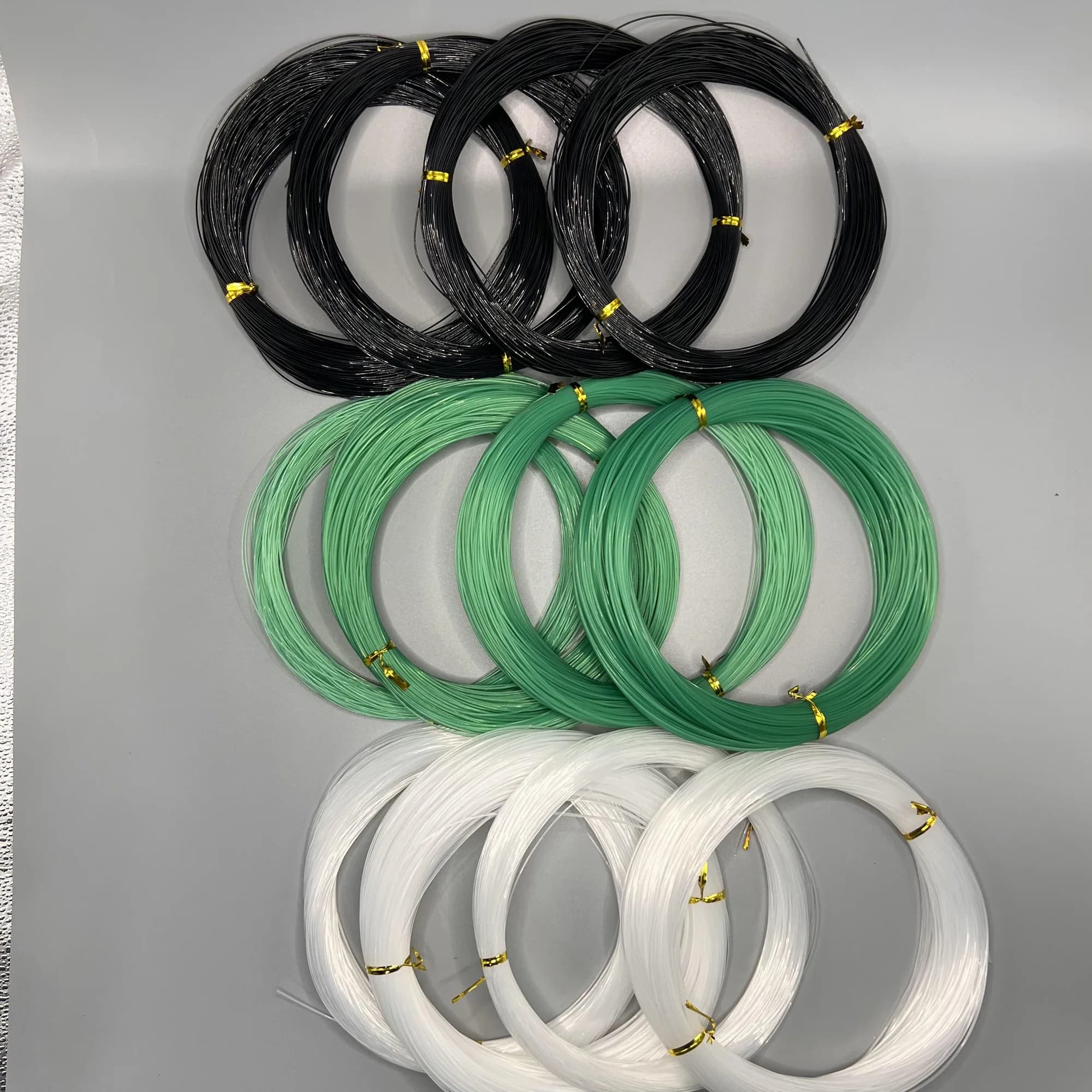
In monofilament fishing net specifications, line diameter usually refers to the thickness of the individual nylon filament, commonly expressed in millimeters. Importers and wholesalers may encounter values such as 0.16 mm, 0.20 mm, 0.30 mm, 0.40 mm or 0.50 mm on labels and specification sheets.
These figures are examples of diameter notation, not a universal stock list or a recommendation for a particular fishery. A useful inquiry combines diameter with material, mesh size, mesh depth, length, knot type, stretching, selvage, color, quantity and packing. This guide explains how buyers can read those fields together before requesting a quote.
What Does Line Diameter Mean in a Fishing Net?
Line diameter is the measured thickness of a single monofilament used to form the netting. In a specification for a nylon monofilament fishing net, it is commonly written in millimeters, for example 0.30 mm. The value should be read as part of the product construction, not as the outside dimension of a knot or a bundle of multiple yarns.
Diameter helps distinguish one monofilament construction from another, but it does not independently define strength, service life or suitability. Material grade, mesh geometry, knotting, finishing and the finished net design also matter. Buyers replacing an existing net should retain the original unit and measurement reference rather than converting it into a local trade number without confirmation.
Line Diameter in a Complete Specification
Material
Confirm the polymer and monofilament construction.
Diameter
State the individual line thickness in millimeters.
Mesh
Add mesh size and the measurement method.
MD
State the number of meshes in the depth direction.
Construction
Confirm knot, stretching and selvage requirements.
Order
Add quantity, color, packing and labeling details.
Common Fishing Net Line Diameter Formats
Buyers may specify diameters such as 0.16 mm, 0.18 mm, 0.20 mm, 0.25 mm, 0.30 mm, 0.35 mm, 0.40 mm or 0.50 mm. Actual production availability should be confirmed with the factory against the full product specification.
| Diameter | How It May Appear in an RFQ | What It Describes |
|---|---|---|
| 0.16 mm | 0.16 / 0.16mm | Monofilament thickness |
| 0.20 mm | 0.20 / 0.20mm | Monofilament thickness |
| 0.30 mm | 0.30 / 0.30mm | Monofilament thickness |
| 0.40 mm | 0.40 / 0.40mm | Monofilament thickness |
| 0.50 mm | 0.50 / 0.50mm | Monofilament thickness |
Line Diameter vs Mesh Size: What Is the Difference?
Buyers often place several measurements in one short RFQ. Each describes a different part of the net. Keeping them in separate fields prevents a supplier from interpreting one value as another.
| Field | What It Describes | Example Format |
|---|---|---|
| Line Diameter | Thickness of one monofilament line | 0.30 mm |
| Mesh Size | Mesh opening under an agreed measurement method | 2 inch |
| Mesh Depth | Number of meshes in the depth direction | 400 MD |
| Net Length | Length under the stated stretched or finished condition | 100 m |
MD is a mesh count rather than a line thickness or metric depth. The fishing net MD guide explains why values such as 100 MD, 200 MD and 400 MD must be read together with mesh size and measurement condition.
Can the Same Line Diameter Be Used with Different Mesh Sizes?
A buyer may encounter the same nominal line diameter in nets with different mesh sizes. That does not make the finished nets equivalent. Mesh opening, depth count, length, knot and stretch orientation can all produce a different construction even when the diameter field is unchanged.
Likewise, two products with the same mesh size can use different diameters when the buyer's established design requires it and the combination is feasible. A quotation should therefore describe the diameter-and-mesh combination rather than asking for “standard” netting. The Fishing Net Specification Matching service can help organize details from an existing label or sample.
Why Line Diameter Affects Fishing Net Pricing
Line diameter affects material use and the construction requested, but buyers should not expect a reliable price from diameter alone. Mesh size, mesh depth, net length, knot type, stretching, selvage, color, production setup, quantity and packing also influence the quotation. A change to one field may alter how the complete net is produced or packed.
For comparable quotations, send the same full specification to each supplier. Asking only for the price of “0.30 mm fishing net” leaves the mesh, MD, length and finishing unknown. Buyers planning repeat or bulk orders can review the commercial RFQ guidance on the Wholesale Fishing Nets page.
Monofilament Diameter vs Multifilament Denier and Ply
Monofilament and multifilament netting use different size descriptions. Monofilament is commonly identified by the thickness of one filament in millimeters. A nylon multifilament fishing net is commonly identified by a yarn construction such as denier and ply.
There is no safe one-line conversion that makes a millimeter diameter directly equivalent to a denier-and-ply construction. Material, filament grouping, twist and manufacturing conventions differ. Preserve the original notation from the approved product and use the fishing net specification guide to check which sizing system belongs in each field.
How to Specify Line Diameter in a Fishing Net RFQ
Write the value, unit and product construction together. Then add the mesh and finished-net fields needed for production review. The example below demonstrates an RFQ format only; it is not a standard product, an inventory item or a recommended specification.
Confirming Diameter From an Existing Net
When an importer wants to reproduce an existing product, an original label or specification sheet is the most useful starting point. A physical sample measured with suitable equipment can provide an additional reference. Measurements should be taken carefully because deformation, coating, wear or an unsuitable tool can affect the result.
A clear photo helps identify whether the net looks monofilament or multifilament and can show mesh and knot construction. It cannot reliably confirm an exact diameter in millimeters because scale, focus and perspective vary. Buyers should avoid approving an exact diameter from a photo alone.
Line Diameter in 400 MD Fishing Net Specifications
400 MD describes only the number of meshes in the depth direction. For example, a buyer may request several mesh sizes with different line diameters within one 400 MD order. Each mesh-size and diameter combination should be listed separately for accurate production and pricing.
The 400 MD fishing net page shows how mesh depth can be combined with buyer-specified line diameter and other construction details. Diameter examples such as 0.16–0.50 mm are not a fixed 400 MD range and must not be treated as a universal standard.
Common Mistakes When Specifying Fishing Net Diameter
Errors to Avoid
Missing Unit
A number without mm or another confirmed unit can be misread.
Local Trade Number
Do not assume a local number equals a millimeter diameter.
Diameter Only
A quote still needs mesh size, MD, length and construction.
Photo Measurement
A product photo cannot establish an exact diameter.
Mono/Multi Conversion
Do not convert diameter directly into denier and ply.
Assumed Availability
Example sizes are not a promise for every specification.
Fishing Net Specification Checklist
- Material
- Monofilament or multifilament
- Mesh size
- Line diameter or denier / ply
- Mesh depth (MD)
- Net length
- Knot type
- Stretching
- Selvedge
- Color
- Quantity
- Packing
- Destination if freight is required
Review the complete fishing net specification guide before requesting wholesale fishing nets. Mark uncertain fields for confirmation instead of guessing.
Fishing Net Line Diameter FAQ
What does fishing net line diameter mean?
Fishing net line diameter describes the thickness of an individual monofilament line, normally stated in millimeters. It is one field in a complete net specification and should be confirmed together with material, mesh size, mesh depth, length, knot, stretching, selvage and quantity.
Is 0.30 mm the same as mesh size?
No. A value such as 0.30 mm describes the thickness of an individual monofilament. Mesh size describes the opening of each mesh under an agreed measurement method. A quotation should state both values separately, together with MD, net length and the other construction details.
Can the same mesh size use different line diameters?
Yes, the same mesh size may be combined with different line diameters when the requested construction is technically feasible. The correct combination should be confirmed from the buyer's existing net, label, specification sheet, market requirement or approved sample.
Why does fishing net line diameter affect price?
A change in diameter may change material consumption, net weight and the production specification. Price also depends on mesh size, MD, total length, knot construction, color, quantity and packing, so a reliable quotation cannot be calculated from diameter alone.
What is the difference between monofilament diameter and multifilament denier?
Monofilament is commonly specified by the diameter of one filament in millimeters. Multifilament netting is commonly described with yarn notation such as denier and ply. Buyers should keep the original notation rather than assuming a direct conversion between the two systems.
What information should I send with the line diameter for a quotation?
Send the material, monofilament construction, diameter in millimeters, mesh size and measurement method, MD, length, knot, stretching, selvage, color, quantity and packing. Mark any uncertain field and include a label, specification sheet or sample reference when available.
Need Help Matching Your Fishing Net Line Diameter?
Send us your mesh size, line diameter, MD, net length and quantity. If you do not have a complete specification sheet, you can send a clear product label, existing sample information or photos for initial specification matching.