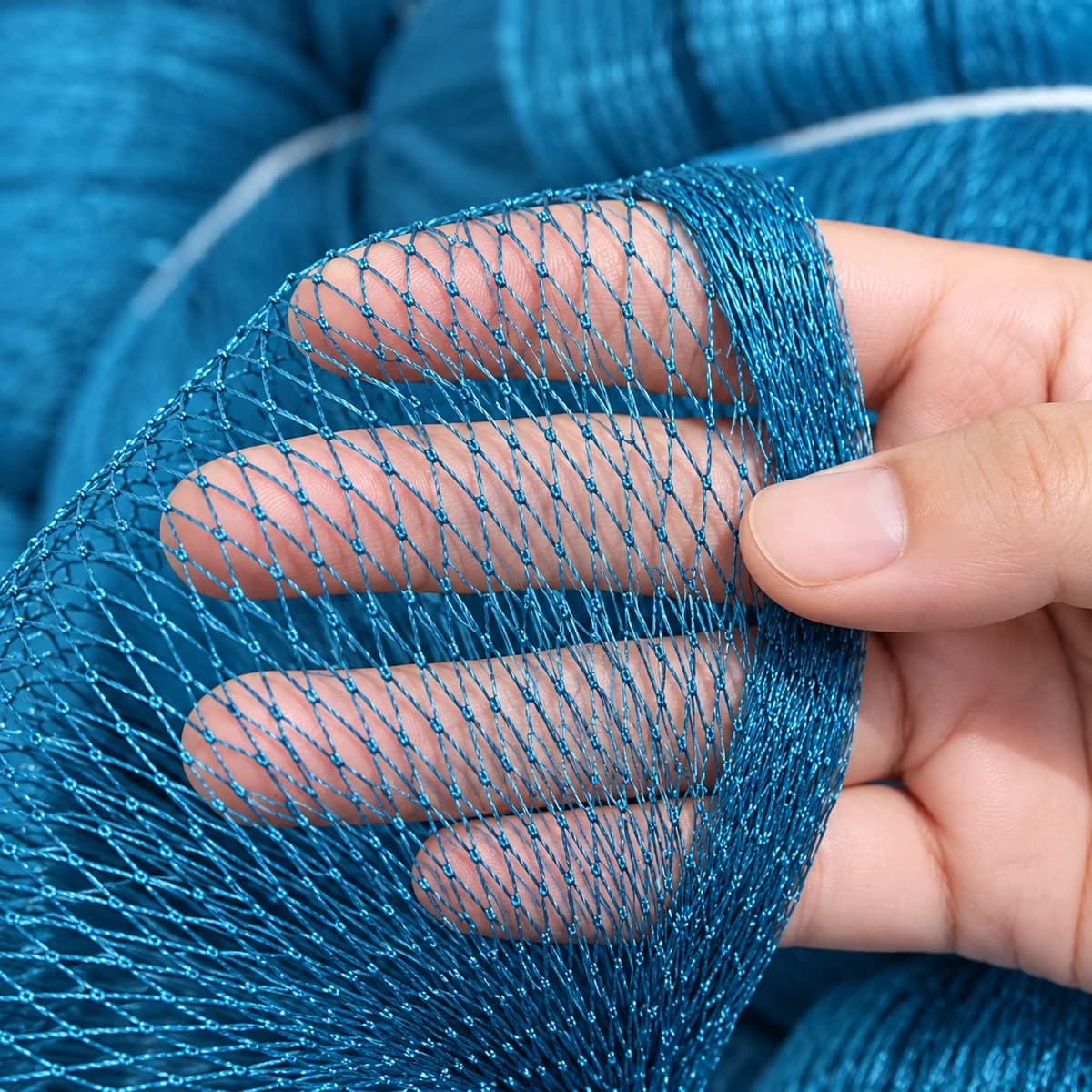
When a buyer compares 210D/6, 210D/9 and 210D/12 nylon fishing nets, the numbers identify yarn construction—not a complete net specification. The ply selection influences nominal linear mass, handling and finished-net weight, while mesh size, mesh depth, length, knot, stretching and selvage determine the netting format that will actually be supplied.
This guide is for importers and wholesalers sourcing a nylon multifilament fishing net. It explains the arithmetic behind the notation and the purchasing details that must be confirmed before comparing quotations.
What 210D/6, 210D/9 and 210D/12 Mean
Denier is the mass in grams of 9,000 meters of yarn. In the notation 210D/9, 210D identifies the nominal yarn size and 9 identifies the stated number of components or plies. Multiplying the two values gives a base nominal denier. Dividing by nine converts that value to nominal tex, or grams per 1,000 meters.
| Construction | Base Nominal Denier | Base Nominal Tex | Base Mass per 1,000 m |
|---|---|---|---|
| 210D/6 | 1,260 denier | 140 tex | 140 g |
| 210D/9 | 1,890 denier | 210 tex | 210 g |
| 210D/12 | 2,520 denier | 280 tex | 280 g |
How the Three Constructions Differ in a Net
Within the same material family, 210D/6 uses less nominal yarn mass per unit length than 210D/9, while 210D/12 uses more. This usually changes the visible twine body and the amount of material in a panel. It does not create a universal ranking for service life or catch performance because the finished result also depends on yarn quality, twist, knot formation, mesh geometry and use conditions.
A buyer should therefore avoid requests such as “use the strongest ply.” Instead, identify the approved construction and preserve the full comparison basis. The fishing net specification guide explains how denier and ply should be recorded alongside the other fields.
Purchasing Comparison
| Buyer Question | 210D/6 | 210D/9 | 210D/12 |
|---|---|---|---|
| Nominal yarn input | Lowest of the three | Intermediate | Highest of the three |
| Weight comparison | Use actual Rtex and panel data | Use actual Rtex and panel data | Use actual Rtex and panel data |
| Quotation requirement | Confirm mesh, MD, length, knot, stretching, selvage, color, quantity and packing | ||
| Selection basis | Approved sample, buyer specification and intended net construction | ||
Even with identical ply notation, two quotations may not be equivalent if mesh measurement, MD, length or finishing differs. For projects where shipment weight matters, use the separate guide on calculating nylon multifilament net weight.
Mesh, MD and Knot Must Be Specified Separately
Ply does not tell the factory the mesh opening or the number of meshes in depth. State the mesh size and measurement method, then provide MD and stretched length. The mesh size buyer guide and MD explanation help keep these dimensions separate.
Knot type also affects material use and handling. If the order can use either SK or DK, ask for both quotations on the same technical basis. For a multifilament-specific decision, see the single-knot versus double-knot nylon multifilament guide.
Example RFQ Format
Send one line for every required variant. Mixed constructions, colors or packing formats are subject to production feasibility and should not be assumed to share one MOQ. For tailored production options, review OEM and custom fishing nets.
Frequently Asked Questions
What does 210D/6 mean?
It indicates six nominal 210-denier yarn components in the stated construction. The base arithmetic is 1,260 denier, or 140 tex, before allowances for twist and finished-twine structure.
Is 210D/12 twice as heavy as 210D/6?
Their base nominal linear masses have a 2:1 ratio, but finished-net weight also depends on actual Rtex, mesh size, MD, length, knot construction, selvage and moisture or conditioning at measurement.
Which ply should a buyer choose?
Choose from an approved product specification, reference sample and target construction. A higher ply changes twine size and net mass, but it should not be selected from ply notation alone.
Can the same mesh size use different ply counts?
Yes, subject to production feasibility and buyer confirmation. Mesh size and ply are separate fields and must both appear in the RFQ.
Does 210D describe breaking strength?
No. Denier describes nominal linear mass, not guaranteed breaking strength. Strength must be confirmed through the agreed material, construction and inspection method.
What should I send for a quotation?
Send material, 210D ply, mesh size and measurement method, MD, length, knot, stretching, selvage, color, quantity and packing, plus a reference sample or label when available.
Need a 210D Multifilament Net Quotation?
Send the ply, mesh size, MD, length, knot, stretching, selvage, color, quantity and packing requirements. We will review the specification before quotation.