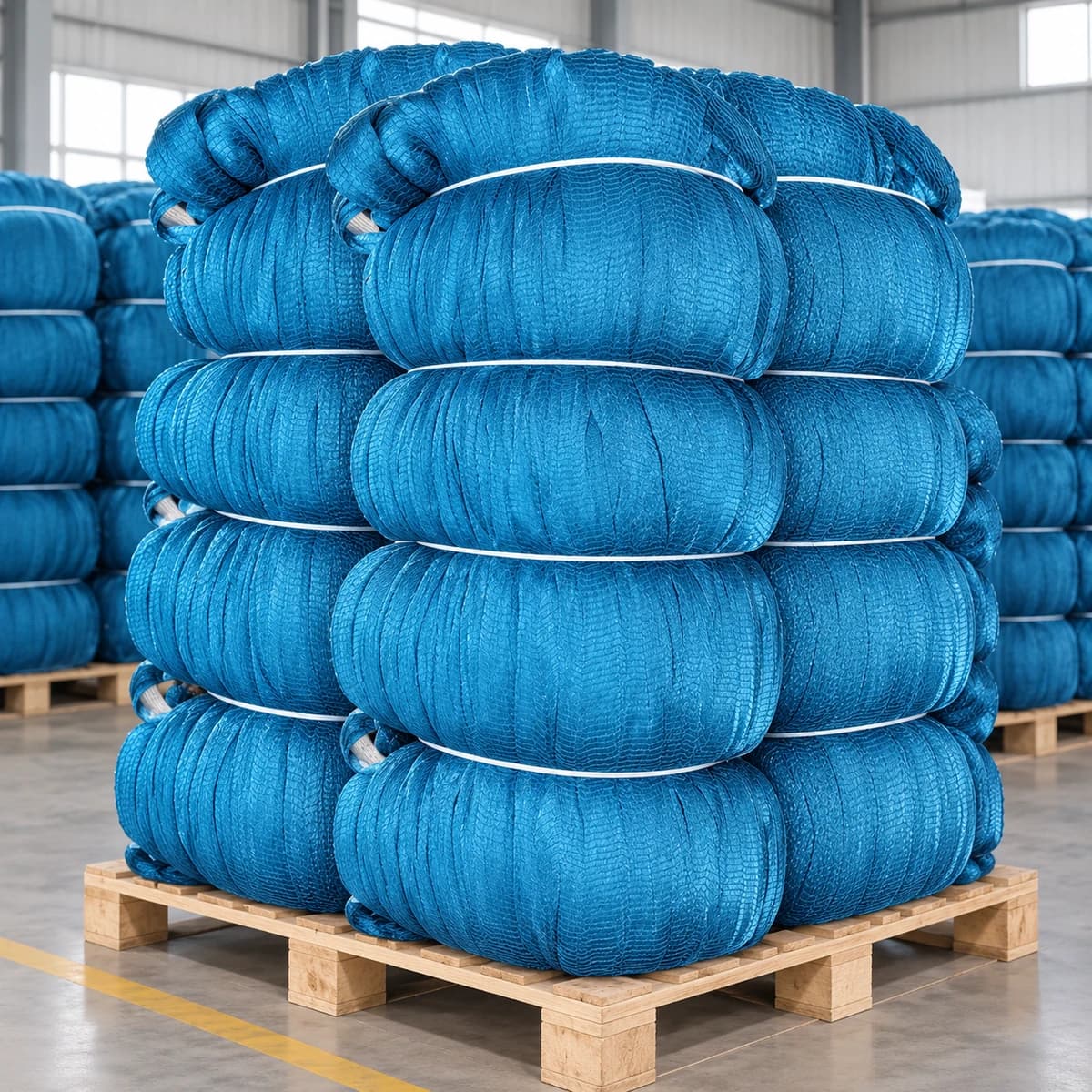
Single knot and double knot are practical purchasing choices in nylon multifilament netting. The knot changes how much twine is concentrated at each mesh intersection and can affect net weight, bulk, handling and dimensional stability. It should be specified together with the yarn construction and panel dimensions—not selected as an isolated marketing feature.
This guide focuses on nylon multifilament fishing nets. For a broader comparison across net materials, use the existing general SK vs DK fishing net guide.
What SK and DK Mean
SK means single knot: one knot construction secures each twine intersection. DK means double knot: an additional knot is formed at the intersection. The buyer should write SK or DK in the RFQ and retain a reference sample when the visual knot form matters.
Neither abbreviation defines nylon grade, denier, ply, mesh size, MD, stretching or selvage. A complete purchase order must state those fields separately.
Single-Knot Multifilament Netting
Single-knot netting uses less knot material than an otherwise comparable double-knot construction. This can reduce bulk at the intersections and may reduce total material consumption. The real difference depends on twine Rtex, mesh size, knot formation and panel dimensions.
SK should not be described as automatically light, weak or economical without a shared specification. A 210D/12 SK panel can contain more material than a 210D/6 DK panel, so quotations must preserve the same twine and dimensional basis.
Double-Knot Multifilament Netting
Double-knot netting adds material at the intersections and is often requested where the buyer's established design calls for additional knot stability. It also creates a different weight and packing basis. Buyers should confirm whether their sample, drawing or market specification actually requires DK.
Do not infer a guaranteed breaking strength from DK alone. Yarn quality, ply, twist, mesh geometry, knot consistency and test method remain important. Production confirmation should be based on the full specification.
SK vs DK Purchasing Comparison
| Point | Single Knot (SK) | Double Knot (DK) |
|---|---|---|
| Knot construction | One knot at the intersection | Additional knot at the intersection |
| Material at knot | Lower on the same comparison basis | Higher on the same comparison basis |
| Weight estimate | Use verified SK correction or sample | Use verified DK correction or sample |
| Selection basis | Buyer specification, approved sample and intended net design | |
The separate multifilament net weight guide explains why one knot factor should not be applied blindly to every construction.
How Twine Size and Mesh Affect the Decision
Knot choice must be evaluated with denier and ply. The 210D/6, 210D/9 and 210D/12 comparison shows how nominal linear mass changes before knot material is considered. Mesh size also changes the number of intersections within a given panel length.
MD and stretched length establish panel scale. Stretching direction and selvage should remain separate specification fields. If the source document is incomplete, review how to read a fishing net specification before requesting prices.
Example RFQ Wording
If both knot options are acceptable, request SK and DK as separate variants with all other fields held constant. That gives an importer a comparable basis for price, estimated net weight and packing.
Knot Confirmation Checklist
- Approved knot sample or clear close-up photo
- Material and 210D ply
- Mesh size and measurement method
- MD and stretched length
- SK or DK stated explicitly
- Stretching and selvage
- Color, quantity and packing
- Inspection or sample requirement
For made-to-order review, see OEM fishing net options.
Frequently Asked Questions
What do SK and DK mean?
SK means single knot and DK means double knot. They describe how the twine intersections are tied in knotted netting.
Is DK always stronger than SK?
No universal claim should be made from the abbreviation alone. Material, twine construction, knot quality, mesh geometry and test method all affect the result.
Does DK make a net heavier?
DK generally uses more twine at each intersection, but the actual difference must be calculated or measured for the specified mesh, twine, MD and length.
Can the same 210D ply be supplied as SK or DK?
It may be possible subject to the product specification and production confirmation. Buyers should request the required knot explicitly rather than assume interchangeability.
Which knot should an importer specify?
Use the approved sample, existing market specification and target net design. If neither is available, submit the complete specification for review before ordering.
What should be included in the RFQ?
Include material, denier and ply, mesh size, MD, length, SK or DK, stretching, selvage, color, quantity and packing.
Need Help Confirming SK or DK?
Send a knot photo or approved sample together with the twine, mesh, MD, length, stretching, selvage and quantity. We can review the construction before quotation.