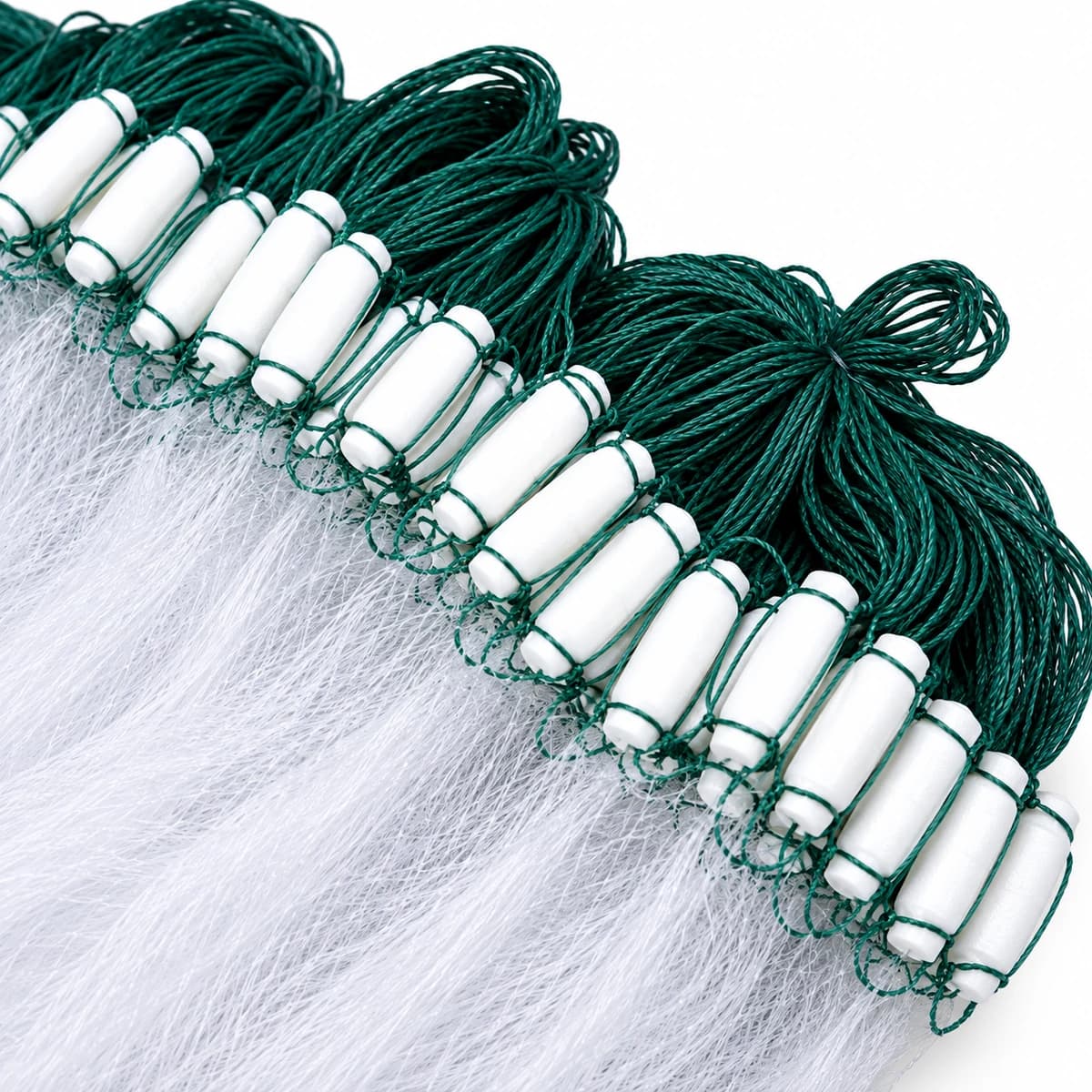
A gill net specification can state the correct mesh size and mesh depth yet still produce a different mounted shape from the buyer's reference net. One reason is the hanging ratio: the relationship between the length of fully stretched netting and the shorter support line on which that netting is mounted.
For importers and fishing-gear distributors, this is not a theoretical detail. It affects how much netting is assembled onto a given rope length, how the mesh opens after mounting, and whether a finished net follows an approved sample or drawing. A quotation for a finished gill net therefore needs more than mesh size, MD and overall length.
What Does Gill Net Hanging Ratio Mean?
The FAO *Fisherman's Workbook* defines the hanging ratio, commonly represented by E, as the length of the support divided by the length of the fully stretched netting mounted on that support. Written as a purchasing formula:
E = mounted support length / fully stretched netting length measured in the same direction
Both lengths must use the same unit and refer to the same section of netting. If a buyer mixes a finished rope length with an unrelated panel dimension, the result is not meaningful.
The ratio may be written as a decimal, such as 0.50, or as a percentage, such as 50 percent. Some markets use terms such as hanging coefficient, mounting ratio or shortening. These labels are not always used consistently, so the RFQ should include the formula or a drawing rather than rely on a term alone.
A Clearly Labelled Calculation Example
The following figures are hypothetical and demonstrate the formula only. They are not a recommended setting for every fishery or a standard FishingNetPro construction.
| Input | Assumed value |
|---|---|
| Fully stretched netting length | 100 m |
| Selected hanging ratio (E) | 0.50 |
| Calculated mounted support length | 100 m × 0.50 = 50 m |
In this example, 100 meters of fully stretched netting is distributed along a 50-meter support. Reversing the calculation, a 40-meter support at E = 0.50 would correspond to 80 meters of fully stretched netting. Before using either calculation in an order, the buyer and supplier must agree how the netting and support are measured.
How Hanging Ratio Changes the Mounted Mesh Shape
Diamond mesh changes shape as the panel is shortened along one direction. A different E value changes the balance between horizontal opening and vertical opening under an ideal geometric model. The netting may appear more open in one direction and deeper or shallower in the other, even though the nominal mesh size and the number of meshes remain unchanged.
This geometric relationship should not be turned into an unsupported performance claim. A particular E value does not automatically improve catch rate, selectivity or service life. Those outcomes depend on the fishing method, species, operating conditions, material, twine construction and local regulations, among other factors.
For mesh terminology and measurement conventions, see the Fishing Net Mesh Size Guide. The measurement method must be agreed before a hanging calculation is used.
Why the Same Mesh Size and MD Can Produce a Different Net
MD states the number of meshes in the depth direction. It does not, by itself, state the finished physical depth of a mounted net. Two panels can have the same mesh size and the same MD yet differ after assembly because their hanging ratios, mounting directions, rope lengths or attachment methods differ.
The MD and mesh-depth guide explains why a mesh count is not a meter measurement. Hanging ratio adds another layer: it describes how netting is distributed on a support, not how many meshes are present.
Top and bottom mounting may also require separate confirmation. A buyer should not assume that one ratio applies identically to both support lines unless the drawing or specification says so. If different arrangements are intended, each one should be identified clearly.
Hanging Ratio Is Not the Same as Stretching Direction
LWSF and DWSF identify the orientation in which netting is stretched or supplied. Hanging ratio describes how netting length relates to its mounted support. They are connected during interpretation but are not interchangeable specification fields.
A complete RFQ can therefore include mesh size, MD, panel length, stretching direction and hanging ratio as separate entries. The fishing net specification guide helps buyers keep these fields distinct.
Measurement Conventions Must Be Confirmed
Hanging-ratio errors often begin with an unstated convention. Before approving a calculation, confirm:
- whether mesh size is stated as stretched mesh, bar length or another agreed method;
- whether netting length is measured fully stretched and in which direction;
- whether the quoted length is loose netting length, mounted headrope length or finished overall length;
- whether E is written as a decimal or percentage;
- whether the same ratio applies at the top and bottom;
- whether selvage, end attachments or other assembly details affect the reference length.
Regional vocabulary can differ. A written equation, annotated drawing or approved physical sample is more reliable than assuming that two suppliers interpret the same abbreviation identically.
What to Put in a Gill Net RFQ
A buyer requesting mounted netting should provide enough information to reproduce the intended geometry. At minimum, include:
| RFQ field | What to state |
|---|---|
| Supply format | Loose netting or finished rigged gill net |
| Material and construction | Buyer-confirmed material, monofilament or multifilament, line diameter or denier/ply |
| Mesh | Size and measurement method |
| Depth | MD and any required finished-depth reference |
| Length | Fully stretched netting length and/or mounted rope length, clearly labelled |
| Hanging ratio | E value, formula convention and whether it applies to top, bottom or both |
| Knot and selvage | Required construction, where applicable |
| Rigging | Rope, float, sinker and attachment details for a finished net |
| Reference | Drawing, label, sample or clear photographs |
The related Gill Net Rigging Guide explains how to specify ropes, floats, sinkers and mounting details without treating common configurations as universal standards.
Why a Reference Sample or Drawing Matters
A sample allows the supplier to examine how the webbing sits on the lines, how attachment points are spaced and whether the top and bottom are assembled differently. A drawing can identify stretched panel length, mounted rope length, MD, mesh direction and the intended E value.
Neither replaces a written specification. Samples can stretch, shrink, wear or lose labels during use. Record the dimensions and measurement conditions rather than asking a supplier simply to “make the same.” If the original ratio is unknown, it may need to be measured and confirmed before production feasibility or pricing is accepted.
Buyer Checks Before Production
- Confirm that the ratio formula is written in the same direction used by the supplier.
- Verify mesh size and its measurement method.
- Separate fully stretched panel length from mounted rope length.
- State MD independently from finished physical depth.
- Mark whether top and bottom use the same mounting basis.
- Attach a drawing or sample reference where possible.
- Confirm the finished rigging components separately.
- Check fishing-gear rules in the destination market.
Local fisheries rules may govern permitted mesh, dimensions, rigging or use. They are not globally uniform. The buyer is responsible for confirming requirements in the intended market and fishery.
Frequently Asked Questions
What is the formula for gill net hanging ratio?
E is commonly calculated as mounted support length divided by fully stretched netting length in the same direction. State the convention in the RFQ because terminology and notation can vary.
Is 0.50 the standard hanging ratio for every gill net?
No. The 0.50 value in this guide is a calculation example, not a universal standard. The required ratio depends on the buyer's established design, use, assembly method and applicable local requirements.
Does a lower hanging ratio always catch more fish?
No such conclusion should be made from the ratio alone. Hanging ratio changes mounted geometry, while fishing performance depends on many interacting factors and should not be guaranteed from one specification field.
Can two nets with the same mesh size and MD have different finished depths?
Yes. Hanging condition, ratio, orientation, construction and attachment method can produce different mounted dimensions even when mesh size and MD match.
Should the top and bottom use the same hanging ratio?
Do not assume they do. State the required arrangement for each support line or provide a drawing or approved sample.
What should I send for a hanging-ratio quotation?
Send the netting construction, mesh and measurement method, MD, fully stretched panel dimensions, mounted rope dimensions, E convention, knot, selvage, rigging details, quantity and a drawing or sample reference. Contact the sourcing team when these details are ready.
Technical References
- FAO Fisherman's Workbook, sections on hanging ratio, mounted netting and ordering nets.
- FAO Gillnet Selectivity Manual: Hanging Ratio, discussion of hanging ratio and mesh geometry.
- FAO technical measures in responsible fisheries, background on passive nets and the need to consider management requirements.
Request a Gill Net Quotation
Send the stretched netting length, mounted rope length, mesh, MD, hanging-ratio convention and rigging drawing. FishingNetPro can review the request with an appropriate manufacturing partner and confirm what is feasible before quotation. No ratio, configuration or MOQ should be assumed until the complete specification has been reviewed. Send your confirmed requirements for quotation.