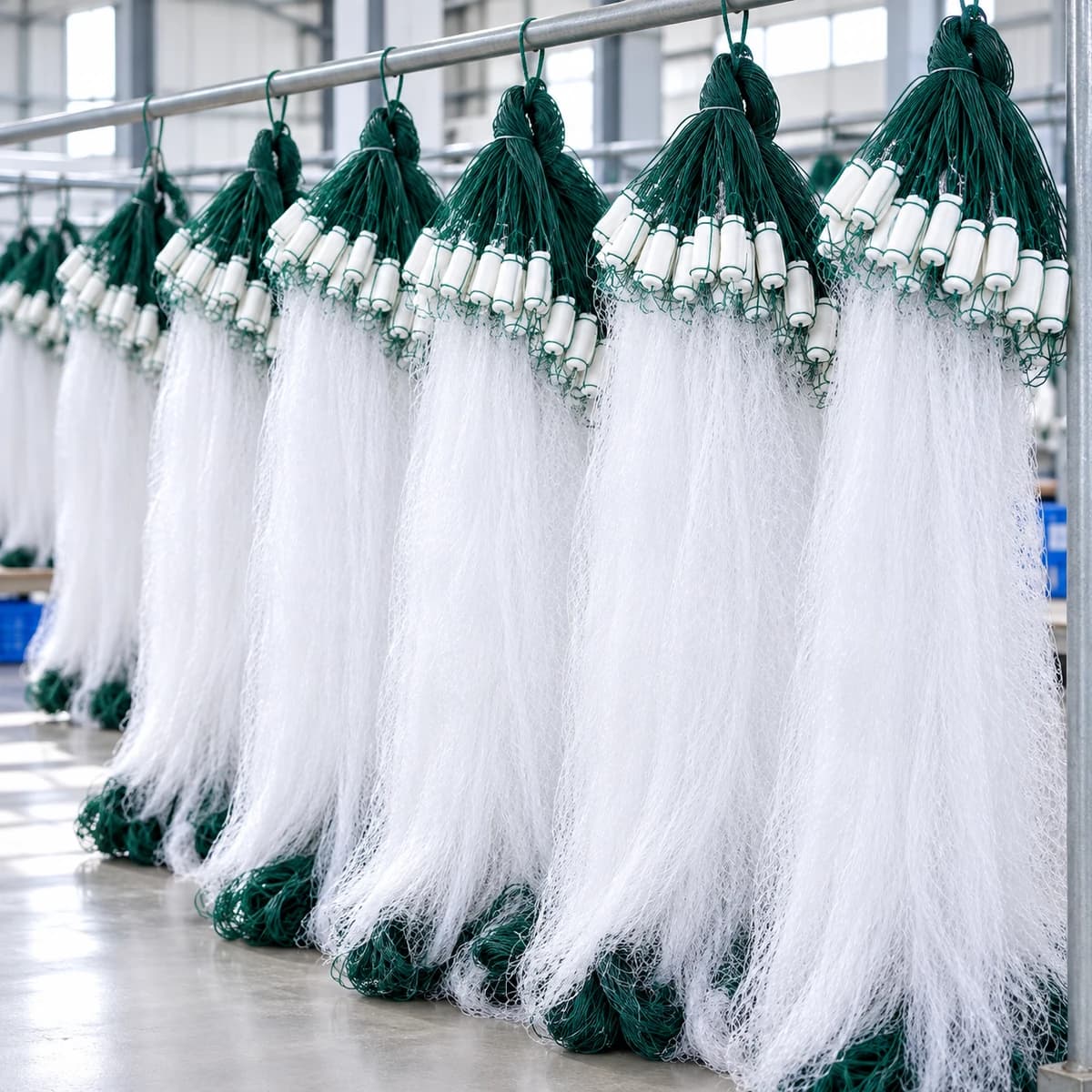
“Gill net” can describe loose netting or a finished assembly with supporting ropes, floats, weights and attachment work. Those are not equivalent supply formats. A buyer who requests only a mesh size and finished length may receive a quotation for netting when the actual requirement is a ready-rigged product.
This guide explains the purchasing vocabulary used for gill net rigging and the details needed to compare quotations. It does not prescribe a universal float spacing, sinker weight or mounting method. Finished configurations must be confirmed against the buyer's drawing, sample, fishing method and local rules.
Gill Netting vs a Finished Rigged Gill Net
Gill netting is the mesh panel before—or without—the complete rope and component assembly. It may be supplied as loose netting, prepared panels or another semi-finished format. A finished rigged gill net normally includes the agreed upper and lower supports plus the specified floats, sinkers or weighted line and attachment details.
The distinction changes material scope, labor, packing and quotation basis. On the Gill Net product page, buyers should state clearly whether they need netting only or a finished net with rigging components.
| Supply format | Buyer should confirm |
|---|---|
| Loose netting | Material, line/twine construction, mesh, MD, panel length, knot, stretching, selvage and packing |
| Prepared panel | All netting fields plus cut or prepared dimensions and edge treatment |
| Finished rigged net | All netting fields plus ropes, floats, sinkers, mounting ratio, attachment method, end details and packing |
Headrope, Float Line, Footrope and Sinker Line
Terms vary among markets and suppliers. The following descriptions provide a working vocabulary, not a claim that every design uses separate components in exactly this way.
| Term | Practical meaning to confirm in an RFQ |
|---|---|
| Headrope / headline | Upper support to which the netting is mounted |
| Float line | Upper line carrying attached floats, or a buoyant line serving the upper support function |
| Footrope / groundrope | Lower support to which the netting is mounted |
| Sinker line / lead line | Lower line with individual weights or an integrated weighted construction |
Some buyers use “headrope” and “float line” interchangeably; others distinguish the structural rope from the float-carrying element. The same issue occurs with footrope, bottom rope, lead line and sinker line. Put the required construction on a drawing and list the component material and dimensions instead of relying on one name.
How to Specify the Float Arrangement
Floats are not adequately described by color or count alone. A buyer may need to identify the float material or approved type, dimensions or model, bore or attachment method, spacing or count per finished length, and the line on which they are mounted. If buoyancy is a contractual requirement, state the agreed unit, method and acceptance basis rather than assume a value from appearance.
Do not copy a float interval from an unrelated net. The correct arrangement depends on the finished design, netting, operating method and buyer's reference. Where an established product is being matched, send a labelled float sample, component photo with scale, or drawing.
How to Specify Sinkers or a Weighted Line
The lower assembly may use individual sinkers, a weighted rope or another buyer-specified system. The RFQ should identify the construction rather than ask generally for a “standard sinker line.” Useful fields include:
- sinker or weighted-line type and material, subject to legal and market requirements;
- dimensions, model or unit mass when these are contractual fields;
- number or spacing over a defined finished length;
- attachment method and orientation;
- lower-line material, construction and diameter;
- total assembly requirement where the buyer has an approved design;
- reference component, drawing or finished sample.
No universal sinker weight or spacing is implied. Material restrictions and fishing-gear regulations can differ by destination and use, so the importer should confirm applicable local requirements.
Connecting the Netting to the Support Lines
The webbing must be connected to the upper and lower supports according to an agreed mounting method. Depending on the design, the specification may need to show attachment twine, meshes between attachment points, distance between mounting points, treatment of selvage, and any end or side construction.
Selvage is the reinforced edge construction of the netting; it is not automatically the same as a float line or sinker line. Buyers unfamiliar with the distinction can consult the SSTB vs DSTB selvage guide.
If the buyer has an approved sample, photographs should show both faces, top and bottom attachments, ends and component markings. A sample without written dimensions can still be misinterpreted, especially after field use has stretched or damaged it.
Mesh, MD, Length and Hanging Ratio Work Together
Rigging cannot be reviewed independently from netting geometry. Mesh size determines the opening under an agreed measurement method. MD counts meshes through the depth. Panel length identifies the netting dimension under a stated condition. Hanging ratio defines how fully stretched netting length relates to the shorter support on which it is mounted.
For calculations and convention differences, use the Gill Net Hanging Ratio Guide. It explains the formula without treating one E value as a universal standard. The Mesh Size Guide and MD Guide address two other fields that should remain separate in the RFQ.
A finished length such as “100 m” is ambiguous unless it is labelled. It could mean fully stretched webbing, mounted headrope length, packed panel length or another basis. State exactly which dimension is being ordered.
A Practical Buyer Specification Table
This table is a checklist, not a standard product specification. Complete only the fields that apply, and attach a drawing for any arrangement that cannot be described clearly in text.
| Specification group | Details to provide |
|---|---|
| Supply format | Loose netting, prepared panel or finished rigged net |
| Netting | Material, monofilament/multifilament, diameter or denier/ply |
| Mesh | Size and measurement method |
| Dimensions | MD, stretched panel length, mounted length and required finished dimensions |
| Construction | Knot, stretching direction and selvage |
| Mounting | Hanging ratio convention, top/bottom arrangement and attachment method |
| Upper assembly | Headrope/float line material, diameter, construction, floats and spacing/count |
| Lower assembly | Footrope/sinker line material, diameter, weight system and spacing/count |
| End details | Side ropes, loops or other buyer-defined finishing where applicable |
| Commercial details | Quantity, color, labels, packing and shipment marks |
| Reference | Approved sample, drawing, component specification or photos |
The broader Fishing Net Specification Guide can help organize material, mesh, line size and construction before rigging fields are added.
What Helps a Supplier Quote Accurately?
A dimensioned drawing is usually the clearest reference for a finished assembly. Mark the top and bottom lines, netting orientation, stretched panel dimensions, mounted dimensions, component spacing and attachment details. If separate components have model numbers or approved samples, label them so that the quotation does not substitute a visually similar item without review.
For repeat procurement, send the previous order specification and state which details may change. A physical sample is useful, but the supplier should not have to infer quantity, packing, materials or acceptance criteria from the sample alone.
Because Gill Net sourcing may involve a manufacturing partner, FishingNetPro should first review the complete specification and confirm feasibility. Availability of a particular component, material or assembly should not be assumed before that review.
Receiving Inspection for Finished Rigged Nets
Inspection should compare delivered goods with the approved drawing, sample and purchase specification. A useful receiving check can include:
- confirm the netting material and line/twine construction;
- check mesh using the agreed measurement method;
- verify MD and the labelled length basis;
- identify upper and lower line materials and dimensions;
- compare float and sinker types, counts or spacing with the approved reference;
- inspect attachment consistency, loose connections and visible damage;
- compare hanging arrangement and finished dimensions under the agreed condition;
- verify color, labels, quantities and packing segregation.
This is not a universal acceptance sampling plan. If the buyer requires a formal sampling method, tolerances or third-party inspection, those requirements should be agreed before production.
Common RFQ Problems
- “Standard rigging” without a drawing: standards and market habits differ.
- Length without a measurement basis: stretched webbing and mounted rope length are not the same.
- Float count without finished length: the spacing cannot be interpreted reliably.
- Sinker weight without stating unit or arrangement: individual and integrated systems are different.
- A photo without scale or component labels: visual similarity does not confirm dimensions or materials.
- Assuming local legality: gear rules vary by jurisdiction and fishery.
Frequently Asked Questions
What is included in gill net rigging?
It can include upper and lower support lines, floats, sinkers or weighted line, attachment twine and buyer-defined end details. The exact scope must be listed because finished configurations vary.
Is a float line the same as a headrope?
Sometimes the terms are used for the same upper assembly; in other specifications they describe separate functions or components. Define the construction on a drawing and list the line and float details.
What sinker weight should I order?
There is no universal value. Use an approved design, sample or engineering requirement that accounts for the intended netting, rigging and fishing method, then confirm feasibility and applicable local rules.
Do I need to state hanging ratio for a finished net?
Yes, when it controls how the webbing is mounted. State the formula convention, mounted length and whether the same arrangement applies to both support lines.
Can a supplier copy rigging from a photo?
A photo helps, but it rarely establishes material, dimensions, weight, spacing or attachment details. Add a dimensioned drawing or physical sample and a written specification.
How should I request a quotation?
State the supply format, netting specification, mesh, MD, stretched and mounted dimensions, hanging ratio, upper and lower assemblies, attachments, quantity and packing. Then send the specification and reference files for review.
Technical References
- FAO Fisherman's Workbook, chapters covering mounted netting, ropes, floats, sinkers and ordering information.
- FAO Gillnet Ordering Information, fields used when ordering mounted gillnets.
- FAO technical measures in responsible fisheries, general descriptions of passive-net components and management context.
Request a Finished Gill Net Quotation
Send a dimensioned rigging drawing, approved sample details and the complete netting specification. FishingNetPro can review the request with an appropriate supply-chain partner and confirm component and assembly feasibility before quotation. Unspecified spacing, weights, materials or stock availability will not be assumed. Submit the drawing and specification for quotation.