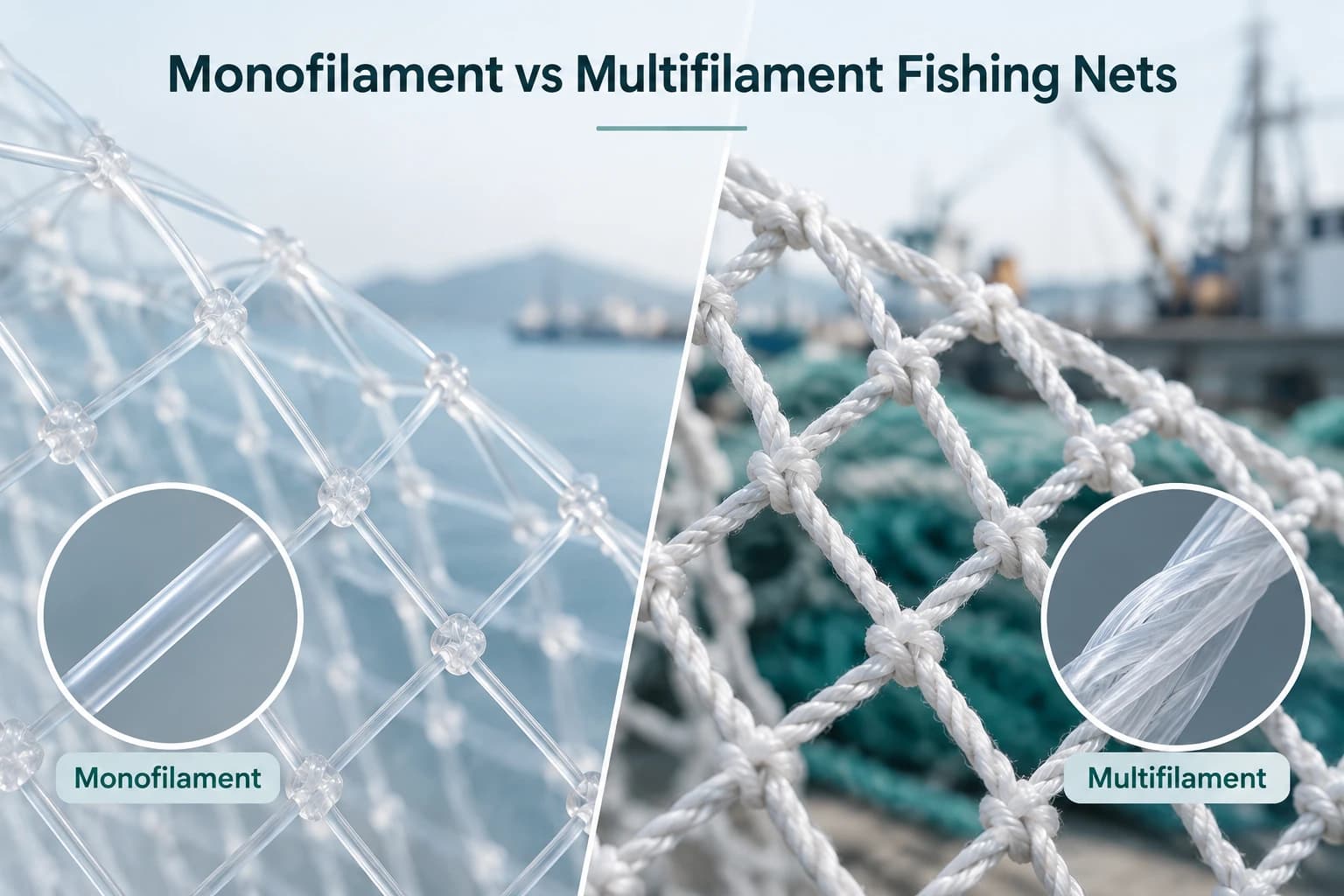
Choosing between monofilament and multifilament fishing nets is not simply a matter of deciding which one is “better.” The right choice depends on the fishing method, target market, mesh construction, yarn or line specification, required dimensions, handling preferences and local buying habits.
For importers, wholesalers, fishing gear distributors and commercial fishing suppliers, understanding the difference between these two net constructions is especially important when preparing specifications for a new order.
This guide explains the main differences between monofilament and multifilament fishing nets and the specifications buyers should confirm before requesting a quotation.
Monofilament Fishing Nets
Specified primarily by filament diameter, mesh size and finished-net dimensions.
Multifilament Fishing Nets
Specified by yarn denier, ply construction, mesh size and finished-net dimensions.
What Is a Monofilament Fishing Net?
A monofilament fishing net is made from individual synthetic filaments used to form the mesh.
For nylon monofilament netting, buyers commonly specify the material together with the filament diameter, mesh size, depth, length, knot construction, stretch direction, color and packing method.
Unlike multifilament netting, which is normally described by a yarn or twine construction, monofilament netting is commonly specified by line diameter, such as a diameter measured in millimeters.
For example, a buyer may request:
- Nylon / PA6 monofilament
- 0.30 mm line diameter
- Specific mesh size
- Required net depth
- Required net length
- Single or double knot
- Specified stretching method
- Required color
- Custom packing
The complete specification matters more than any single value.
For available construction options, see our Nylon Monofilament Fishing Net page.
What Is a Multifilament Fishing Net?
A multifilament fishing net is constructed from yarn made up of multiple fine filaments combined into a twine.
Instead of specifying only a line diameter, buyers normally identify the required yarn or twine construction.
For nylon multifilament netting, specifications may include a notation such as 210D together with the required ply or completed twine construction.
A typical purchasing specification may include:
- Nylon / PA6 multifilament
- Required 210D and ply construction
- Mesh size
- Net depth
- Net length
- Knot type
- Stretching method
- Selvage
- Color
- Packing
It is important not to send only “210D” when requesting a quotation. The full twine construction should be provided whenever possible because different ply configurations can result in different finished net requirements.
See our Nylon Multifilament Fishing Net page for typical reference specifications.
Monofilament vs Multifilament Fishing Nets: Key Differences
The most important difference is the construction of the line or yarn forming the net.
| Comparison | Monofilament Net | Multifilament Net |
|---|---|---|
| Construction | Individual filament | Multiple fine filaments combined into yarn |
| Common specification | Line diameter in mm | Denier / ply or twine construction |
| Typical material option | Nylon / PA | Nylon / PA |
| Mesh customization | Available | Available |
| Knot options | Depends on specification | Depends on specification |
| Length and depth | Buyer-specified | Buyer-specified |
| Color | Buyer-specified | Buyer-specified |
| Packing | Wholesale or custom packing | Wholesale or custom packing |
| Best choice | Depends on fishing method and market | Depends on fishing method and market |
Neither construction should automatically be considered superior for every application.
For B2B sourcing, the better question is:
Which construction matches the product already used in your target market?
That usually produces a much more useful answer than simply asking which net is stronger or better.
1. Line Construction
Monofilament netting is based on individual filaments.
Multifilament netting uses yarn made from multiple filaments.
This structural difference affects how buyers describe the product when sending specifications.
For monofilament nets, the filament diameter is an important purchasing parameter.
For multifilament nets, the twine or yarn designation and ply construction become important.
Confusing these two specification systems is a common source of misunderstanding when requesting quotations.
2. Diameter vs Twine Size
This is one of the most important differences for importers and distributors.
A monofilament inquiry may state:
Line Diameter: 0.30 mm
A multifilament inquiry may instead use a construction such as:
Twine: 210D with specified ply
These numbers cannot be compared directly as if they represented the same measurement system.
When replacing an existing product, buyers should ideally provide the original specification sheet, sample, measurement diagram or clear product photos.
This helps the manufacturer identify the required construction more accurately.
3. Handling and Net Construction
Monofilament and multifilament netting can feel and behave differently because their line structures are different.
Multifilament yarn is made from multiple fine filaments, while monofilament uses individual filaments.
However, final handling characteristics are also influenced by:
- Line or twine thickness
- Mesh size
- Knot construction
- Net depth
- Stretching method
- Finishing process
- Material specification
For this reason, buyers should avoid selecting a fishing net only from a general description such as “soft net,” “strong net” or “heavy net.”
Technical specifications provide a much clearer basis for sourcing.
4. Visibility and Fishing Application
Monofilament netting is often selected in fishing applications where buyers want a relatively low visual profile in the water.
However, actual visibility can vary according to filament diameter, color, water conditions and net construction.
Multifilament netting has a different yarn structure and is widely used in commercial fishing net applications where that construction is already established in the local market.
There is no universal rule that one construction will perform better in every fishing environment.
When sourcing for an existing market, matching the locally accepted product specification is usually more important than changing materials based only on a general comparison.
5. Mesh Size
Both monofilament and multifilament fishing nets can be manufactured with different mesh sizes.
But buyers should clearly identify how the mesh is measured.
Depending on the market, mesh terminology and measurement methods may differ. Our mesh-size guide for commercial buyers explains the main measurement and selection checks.
A specification should therefore include:
- Required mesh size
- Unit of measurement
- Measurement method where necessary
- Reference sample or diagram if available
For large or repeat orders, confirming the measurement method before production can prevent significant misunderstandings.
6. Net Depth and Length
Mesh size alone is not enough to quote a finished fishing net.
Buyers should also specify the required:
Depth — often expressed in mesh depth (MD) or another agreed measurement.
Length — normally specified in meters or according to the buyer's established product format.
Two nets using the same material and mesh size may still be completely different products if their depth, length or construction differs.
7. Knot Type
Depending on the requested product, fishing nets may use different knot constructions, including:
- Single Knot (S/K)
- Double Knot (D/K)
- Knotless construction where applicable
The required knot type should be stated in the inquiry instead of being assumed. See the single-knot and double-knot comparison for the separate construction considerations.
This is particularly important when a buyer is reproducing an existing specification for wholesale distribution.
8. Stretching Direction
Buyers may also encounter specifications referring to stretching direction, such as length-way or depth-way stretching.
The finished dimensions of the net can depend on how the mesh is stretched and measured.
If your existing supplier uses terms such as LWS, DWS, LWSF or DWSF, include the original terminology in your inquiry together with a reference drawing or sample when possible. The lengthway versus depthway stretching guide provides a focused explanation.
Do not convert the specification unless you are certain both parties are using the same measurement method.
Which Fishing Net Should a Buyer Choose?
There is no single answer.
Consider monofilament netting when:
Your market already uses monofilament fishing nets, your existing specification is based on filament diameter, or your fishing method requires a monofilament construction.
Consider multifilament netting when:
Your target market commonly uses twisted or combined nylon yarn netting and the product specification is based on denier, ply or twine construction.
For distributors introducing a new product, it can also be useful to compare physical samples before committing to a larger order.
What Information Should You Send to a Fishing Net Manufacturer?
A complete inquiry can significantly reduce quotation time and specification errors.
Whenever possible, provide:
- Material
- Monofilament diameter or multifilament twine specification
- Mesh size
- Mesh measurement method
- Length
- Depth
- Knot type
- Stretching direction
- Selvage requirements
- Color
- Float and sinker configuration if required
- Packing requirements
- Estimated order quantity
- Reference photos, drawings or samples
If you do not have every specification, send the information you already have.
A reference sample or clear photo can often help identify which additional details need to be confirmed.
Custom and OEM Fishing Net Production
Commercial fishing markets often require different combinations of mesh size, diameter, yarn construction, dimensions, colors and packaging.
For this reason, fishing nets for wholesale and distribution are commonly produced according to buyer specifications rather than one universal standard.
FishingNetPro supports specification-based production for importers, wholesalers, distributors and fishing gear brands.
Available requirements can be reviewed for material, mesh, diameter or twine construction, length, depth, color, knot, stretching method, selvage and packaging.
Learn more about our OEM & Custom Fishing Nets process.
Frequently Asked Questions
Is monofilament better than multifilament fishing net?
Not necessarily. The correct choice depends on the fishing method, target market, required construction and existing buyer specification. Neither type is universally better for every fishing application.
What is the main difference between monofilament and multifilament fishing nets?
Monofilament netting is formed from individual filaments, while multifilament netting is made from yarn containing multiple fine filaments. They are also normally described using different specification systems.
How do I specify monofilament fishing net thickness?
Monofilament fishing net specifications commonly use filament or line diameter, often expressed in millimeters. Always provide the complete net specification together with the diameter.
What does 210D mean in multifilament fishing nets?
210D is a yarn denier reference. It should not normally be used alone when ordering a finished net. Buyers should also provide the ply or twine construction, mesh size, dimensions and other required net specifications.
Can mesh size be customized?
Yes. Mesh size can be reviewed according to the required fishing net specification. Buyers should also confirm the mesh measurement method to avoid differences in interpretation.
Can monofilament and multifilament nets be customized for wholesale orders?
Yes. Material, mesh, line or twine construction, length, depth, knot type, stretching method, color, selvage and packaging can be reviewed according to buyer requirements.
What should I provide for a quotation?
Send your material, diameter or twine size, mesh size, length, depth, knot type, stretch type, color, packing requirements and estimated order quantity. Reference photos or specification sheets are also useful.
We can review the available information and help identify the specifications that need to be confirmed before quotation.